


Google Ads vs affiliate marketing is a choice between buying demand directly and paying partners for measurable results. Google Ads offers speed, control, and intent-based targeting, while affiliate marketing can provide scalable, performance-based acquisition. For many high-intent businesses, the strongest approach combines both channels rather than treating them as permanent alternatives.

What is the difference between Google Ads and affiliate marketing?
Google Ads is a paid media channel. Your business bids to place ads on Google Search, YouTube, Display, or partner properties, and you generally pay when someone clicks or views an ad. You control the campaign, targeting, creative, budget, landing page, and conversion strategy.
Affiliate marketing is a partnership channel. Affiliates, publishers, creators, media buyers, or other acquisition partners promote your offer and receive a commission when they generate a defined result, such as a qualified lead, application, sale, or funded account.
The practical distinction is risk allocation:
- Google Ads: You pay for traffic, whether or not it converts.
- Affiliate marketing: You usually pay after an agreed conversion occurs.
- Google Ads: Your team controls execution directly.
- Affiliate marketing: Partners contribute reach, expertise, and distribution.
Both can target high-intent prospects. The right choice depends on your economics, compliance requirements, conversion tracking, and ability to manage volume.
Google Ads vs affiliate marketing: which is better?
Neither channel is universally better. Google Ads is often better when you need immediate traffic, precise keyword control, and rapid testing. Affiliate marketing is often better when you want performance-based cost structures, additional distribution, or access to partners already trusted by your audience.
A simple rule is useful: choose Google Ads when you can reliably turn predictable clicks into profitable customers. Choose affiliate marketing when qualified partners can reach prospects more efficiently than your internal team can. Use both when they solve different parts of the funnel.
For an overview of how partner-led acquisition can support growth, visit For Partners .
A practical decision framework
Score each channel against the factors that matter most to your business:
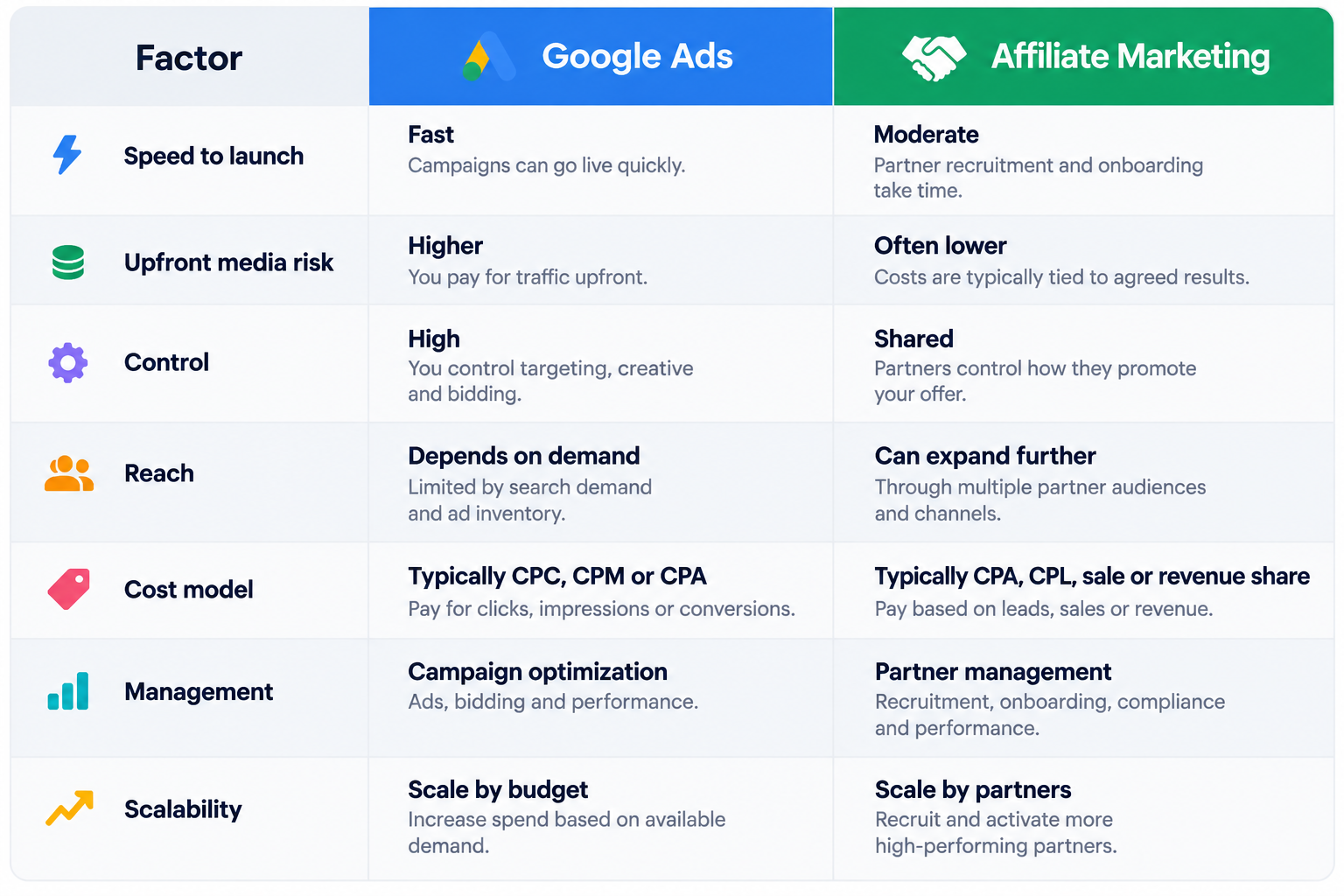
Start with the channel that matches your biggest constraint. If the constraint is learning speed, begin with Google Ads. If it is distribution or upfront risk, test affiliate marketing. If it is profitable volume, build a measured combination.
How can you use both channels together?
A combined strategy can reduce dependence on any single source while improving decision quality. For example, paid search can capture existing demand while affiliates create new entry points through content, communities, email, or specialized media.
Avoid allowing the channels to compete blindly. Set rules for branded keywords, retargeting, coupon traffic, and attribution. Decide whether affiliates may bid on your brand, whether those conversions receive full commission, and how overlapping touchpoints are credited.
Review performance by customer quality, not just reported conversions. A partner with a higher nominal CPA may be more valuable if its customers retain longer or convert at a higher rate.
Common mistakes to avoid
- Choosing the lowest CPA without checking lead quality.
- Launching affiliate traffic without clear compliance rules.
- Scaling Google Ads before conversion tracking is trustworthy.
- Comparing a media cost with a commission without normalizing the conversion event.
- Treating all partners, keywords, or placements as equally valuable.
Final takeaway
Google Ads vs affiliate marketing is not simply a contest between paid clicks and commissions. Google Ads is strongest when you need control, speed, and direct access to existing intent. Affiliate marketing is strongest when you want performance-based acquisition and broader partner-led distribution. Evaluate both using approved revenue, contribution margin, lead quality, and operational effort. Start with the channel that addresses your current constraint, then test the other with clear tracking and quality rules. For many high-intent businesses, a coordinated mix produces more resilient growth than relying on one channel alone.